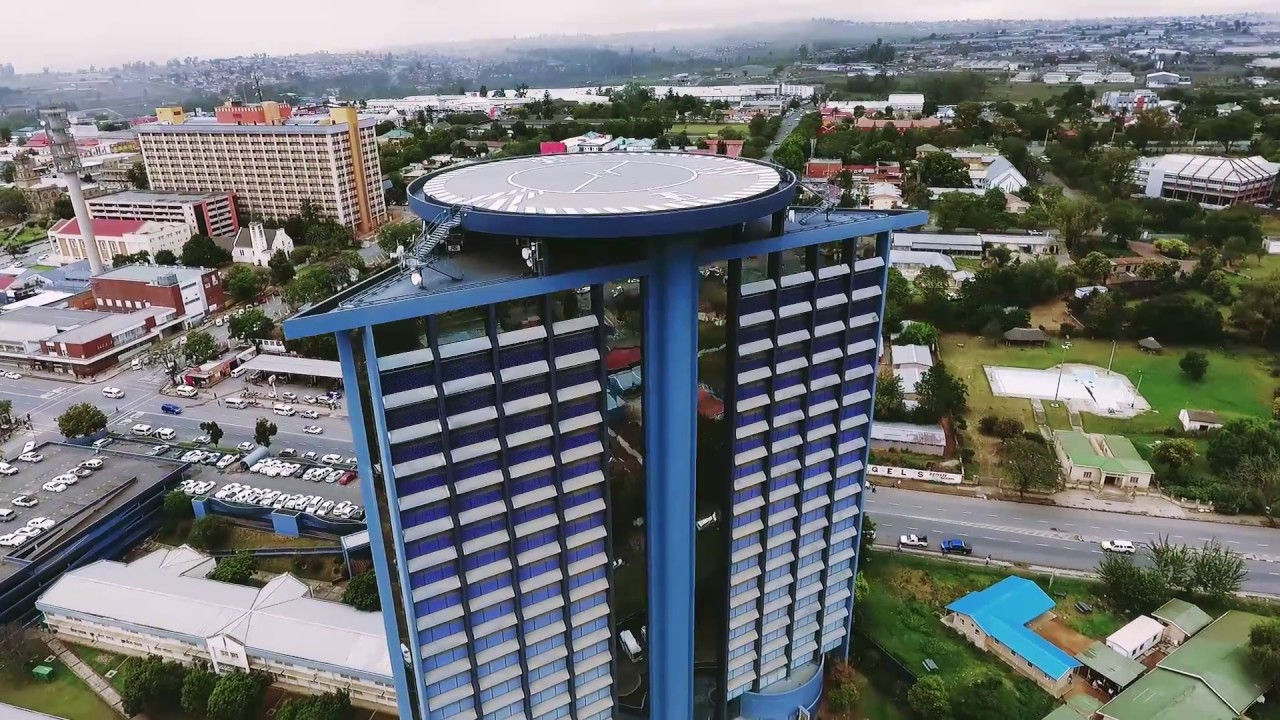
The PRD Office Tower
Civic Landmark
This complex was commissioned by the Public Debt Commission on behalf of the Government of the Republic of Transkei. The brief was clear: to accommodate six of the top government departments within 12,000 square metres of usable office space, while addressing their respective security requirements.
Beyond the office accommodation, the programme called for a 150-seat auditorium, a cafeteria for 180, a private lift, a helicopter landing pad, and parking for 415 vehicles — including a secure, private garage for the Head of State.
The site is positioned at the periphery of Umtata’s Central Business District, at the intersection of Sutherland Street and Stanford Terrace — roads earmarked as future arterial routes through the city. North-facing and containing two recently renovated buildings that had to be retained, the site came with both constraints and opportunity.
The architectural response was conceived as a bold urban statement — one that reflects the stature and importance of a new government institution. Formal strength and vivid colour were employed to assert presence and identity. At the same time, the building needed to be adaptable — a commercial office environment capable of accommodating changing departmental needs over time.
The envelope had to perform as much as it expressed. Sun control, ventilation, and air-conditioning were integrated to ensure occupant comfort, while the electrical infrastructure was designed to accommodate evolving technology of the time and the increasing demands of a modern, computerised workplace.
Security requirements were central to the brief — and a key determinant in the design. Chief among these was the mitigation of threats such as car bombs, which necessitated a 30-metre setback from any road or parking area. The triangular portion of the site — the only area unencumbered by existing structures — became the footprint for the office tower, shaping its plan form. The overall height of the building was driven by the need to satisfy the specified office area.
The resulting structure is a 70-metre-tall office tower comprising 23 levels. The lower ground floor houses core service functions. The upper ground level contains the auditorium and cafeteria. Above this are 18 typical office floors, two upper service levels, and a rooftop helipad.
A second major security consideration was access control. The requirement was to limit entry to three points: a single pedestrian entrance, a vehicular entrance for staff and visitors, and a separate entrance for service vehicles and the Head of State. Each access point includes dedicated security checkpoints. The primary pedestrian entrance — a two-storey security building — was placed at the intersection of the tower, parking structure, and retained buildings. It accommodates all monitoring and detection systems and manages controlled access through a range of electronic systems: from metal detectors to full-height security booths. Access to the tower itself is strictly limited, granted only under specific circumstances.
The building was designed to assert physical and symbolic prominence as the principal seat of government administration in the region. Yet, its visual presence was also shaped by a desire for contextual resonance. The colour of the tower was graded to blend with the grey-blue tones of the surrounding hills and mountains, while its base was anchored by earthen-coloured drums at each corner. At street level, the perimeter wall was articulated with shifts in plane — both horizontal and vertical — softening the edge and inviting interaction. The design of the pedestrian interface was deliberately accentuated to encourage engagement and activity at the urban scale.
In its form, its colour, and its presence, the building reflects an African architectural language: bold, grounded, and responsive. It was envisioned not merely as a workplace, but as a civic landmark — one that embodies the spirit of the client’s original slogan for the project: “The future belongs to us all”.