59 Musgrave Road
An Architectural Dialogue Between Past and Present
The question of how to extend and restore historic buildings has occupied architects for centuries. Since the 18th century, theorists have debated the merits of intervention, with figures such as William Morris advocating for a respectful approach. His founding of the Society for the Protection of Ancient Buildings in 1877 established principles that remain relevant today — chief among them, that new additions should complement rather than imitate, responding to the original with dignity and restraint.
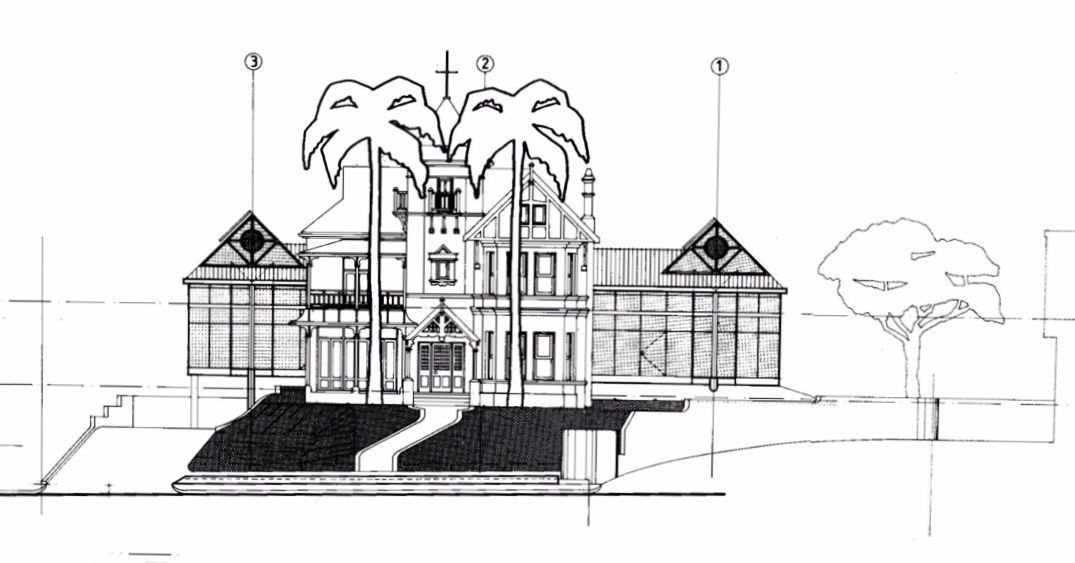
At 59 Musgrave Road, the extension to a Victorian villa was guided by this ethos. The design separates old and new — visually and, where possible, physically — ensuring that the historic fabric is neither overshadowed nor mimicked. The new addition takes the form of a contemporary steel-and-glass pavilion: a clear, modern counterpoint that engages in dialogue with the existing structure. Its presence is assertive, yet deferential—picking up on the scale, line, and proportion of the original without replicating its language.
This is not an exercise in stylistic mimicry, but in understanding. An analysis of the villa’s composition revealed an asymmetry defined by the interplay between its vertical elements — the tower and gable — and the horizontal spread of the verandah. These relationships create a centre of gravity around which the new addition is choreographed. In plan and elevation, the pavilion extends this compositional logic — introducing new gables and layering facades to echo the spatial rhythms of the original.
The result is a building that is unified but not uniform — one in which symmetry and asymmetry co-exist in a dynamic architectural conversation. The new work reveals itself selectively, glimpsed behind the historic structure, maintaining the primacy of the original house while adding complexity and depth to the site.
Central to this design is a loosely held contextualism. This is not context as pastiche, but context as resonance. The architecture draws inspiration from local culture, climate, and vegetation: deep overhangs and shaded verandahs evoke colonial verandah houses, while slender steel columns reference the cast-iron structures of Victorian railway sheds. These are not literal borrowings, but subtle allusions — anchoring the new building in its place and memory.
In this way, the extension becomes more than an addition—it is a reinterpretation. It bridges the rational precision of a modern structural system with the intuitive spirit of the original, linking present to past and past to future. It is a contemporary response that holds within it the spirit of the “genius loci”—the sense of place that makes architecture meaningful.
The original house sat as a villa in a lush garden setting. In keeping with the Picturesque tradition, access was designed to unfold obliquely — guiding visitors past mature palm trees that frame the entrance and anchor the house within its landscape. The architecture of the villa, too, was expressive: the verticality of its tower and gables balanced by the horizontal plane of the wide verandah.
These qualities inspired the language of the new structure. A deep steel roof — its lightness supported by slender columns — references Victorian pragmatism while introducing a contemporary material palette. Joints are expressed with clarity: post to beam, balustrade to wall, steel to glass. The roof is modulated with skylights that echo the gabled forms of the original house, while introducing lightness and rhythm to the deep overhangs.
The junction between old and new is carefully considered. Set back in plan, the new structure respects the autonomy of the villa while gently embracing it. Walls and roofs wrap around at right angles, forming a quiet yet confident interface. This link becomes both a physical and symbolic bridge — connecting vertical levels and architectural eras.
Throughout, the design resists replication. Instead, it seeks to distil and reimagine. The structural expression of the new pavilion — recalling the tracery of Victorian sheds — is not historicist but interpretive, allowing memory to inform rather than dictate form. The deep overhangs, steel detailing, and shifting geometries reflect a concern for climate, character, and continuity.
In this way, the project moves beyond restoration or extension. It becomes an act of architectural storytelling — where the past is neither preserved in stasis nor lost to reinvention, but honoured through intelligent, responsive design.